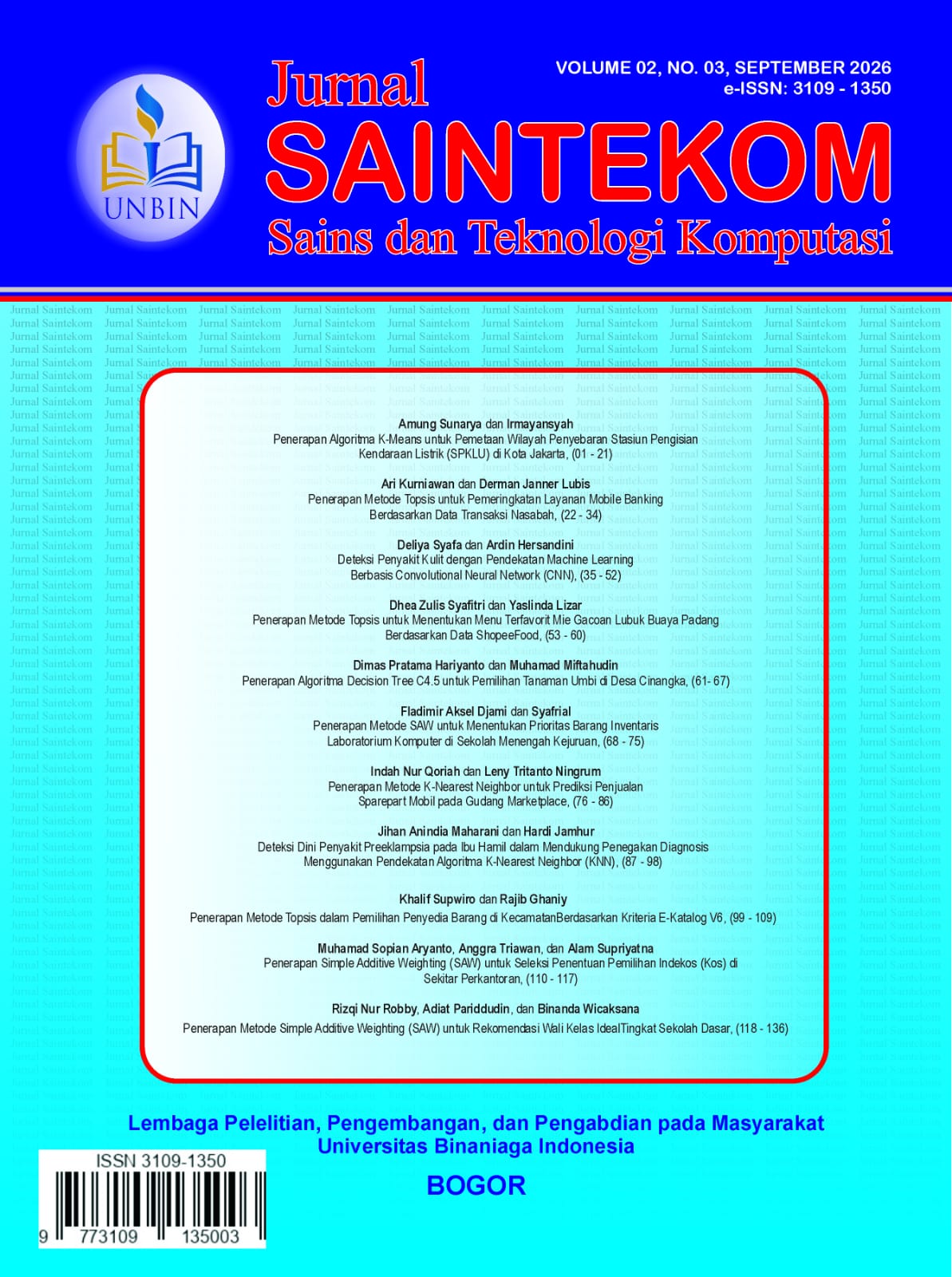
Penerapan Algoritma K-Means untuk Pemetaan Wilayah Penyebaran Stasiun Pengisian Kendaraan Listrik (SPKLU) di Kota Jakarta
DOI:
https://doi.org/10.36350/jskom.v2i3.118Kata Kunci:
K-Means Algorithm, SPKLU Mapping, Prototype, Robust Scaler, Silhouette CoefficientAbstrak
The adoption of electric vehicles (EVs) has shown significant growth in many countries, including Indonesia. However, this increase has not been fully matched by the availability and optimal distribution of Public Electric Vehicle Charging Stations (SPKLUs). This condition is reflected in the existence of SPKLUs operating at full capacity, while others remain underutilized, indicating inefficiencies in infrastructure planning. This study aims to apply the K-Means Clustering algorithm to analyze and map the distribution of SPKLUs in Jakarta. The dataset was obtained from an SPKLU developer company, covering the period from January 2021 to April 2025, and includes five key attributes: installed power capacity (kW), energy consumption (kWh), number of transactions, number of chargers, and number of connectors. The research methodology follows a Research and Development (R&D) approach with a prototyping model. The initial stage involved normalizing the data using the Robust Scaler method, followed by clustering using the K-Means algorithm. The results show that the distribution of SPKLUs can be categorized into three clusters: Cluster 0 (Low) with 180 SPKLUs (82.2%), Cluster 1 (Medium) with 35 SPKLUs (16%), and Cluster 2 (High) with 4 SPKLUs (1.8%). Validation using the Silhouette Coefficient produced an average score of 0.66, indicating that the clustering structure is at a good level. Furthermore, this study developed a prototype web-based application implementing the K-Means method to visualize the clustering results. In conclusion, the findings demonstrate that the K-Means clustering approach can serve as a decision-making basis for the distribution planning of SPKLUs in Jakarta.
Unduhan
Referensi
[1] L. Ketahanan and N. Ri, “Peningkatan penggunaan kendaraan listrik nasional guna mendukung ekonomi hijau,” pp. 1–105, 2023.
[2] Databoks, “Riset Deloitte dan Foundry: Penggunaan Motor Listrik di Indonesia Naik 13 Kali Lipat dalam Dua Tahun,” Katadata, p. 1, 2023, [Online]. Available: https://databoks.katadata.co.id/datapublish/2023/09/15/riset-deloitte-dan-foundry-penggunaan-motor-listrik-di-indonesia-naik-13-kali-lipat-dalam-dua-tahun
[3] M. I. Asaad, “Road Map Pengembangan Infrastruktur Kendaraan Listrik 2020 -2024,” Roadmap infrastruktur kendaraan Elektr., vol. 1, no. September, p. 26, 2020, [Online]. Available: shorturl.at/jxHLM
[4] A. M. Sugieanto, “Penentuan Lokasi Stasiun Pengisian Kendaraan Listrik Umum Yang Optimum Dengan Menggunakan Analisis Spasial,” 2022, [Online]. Available: https://repository.its.ac.id/93907/
[5] R. Oktavia et al., “Penerapan Metode Algoritma K-means Dalam Pengelompokan Angka Harapan Hidup Saat Lahir Menurut Provinsi,” J. Penerapan Sist. Inf. (Komputer dan Manajemen), vol. 1, no. 4, pp. 154–161, 2020, [Online]. Available: https://tunasbangsa.ac.id/pkm/index.php/kesatria/article/view/41
[6] N. Azwanti and N. E. Putria, “Penerapan Algoritma K-Means Untuk Pemetaan Penerimaan Bantuan Kesejahteraan Masyarakat di Kota Batam,” Pros. Semin. Nas. Ilmu Sos. dan Teknol., vol. 5, no. September, pp. 250–256, Sep. 2023, doi: 10.33884/psnistek.v5i.8092.
[7] P. J. Rousseeuw, “Siluet : bantuan grafis untuk interpretasi dan validasi analisis klaster,” vol. 1, 1987.
[8] S. Suhirman, Data Warehouse dan Data Mining, no. January. 2023. [Online]. Available: https://digitalpress.gaes-edu.com/index.php/gaespace/article/view/122
[9] P. Rahayu et al., Buku Ajar Data Mining, vol. 1, no. January 2024. 2018.
[10] F. SLN, Buku Dasar Data Mining from A to Z, no. January. 2023.
Unduhan
Diterbitkan
Terbitan
Bagian
Lisensi
Hak Cipta (c) 2026 Jurnal SAINTEKOM (Sains dan Teknologi Komputasi)

Artikel ini berlisensi Creative Commons Attribution-NonCommercial 4.0 International License.